
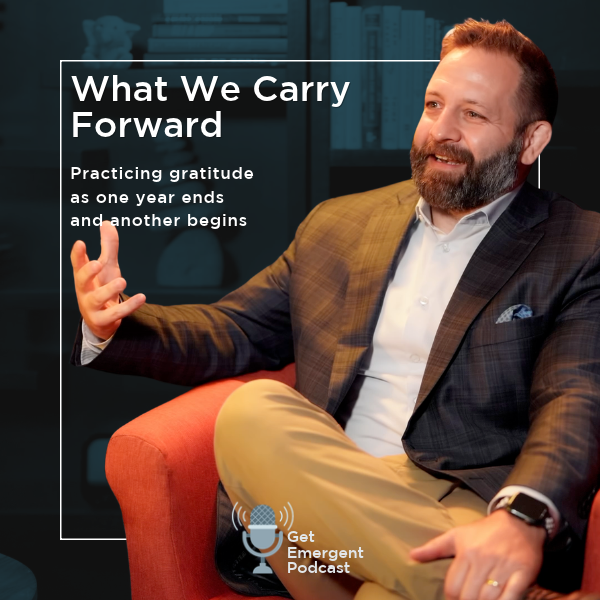
The end of the year often brings a rush to plan what’s next. What might we learn if we pause first? In this episode of the Get Emergent podcast, Bill Berthel and Jeremiah Poulsen explore gratitude in leadership through Thanksgiving traditions, year-end reflection, and the sometimes bittersweet experience of closing a chapter. They share how a simple opening question can help teammates get to know each other, why it matters to explain what you hope to learn when asking for feedback, and what a sincere “thank you” can do when that feedback is hard to hear.
Prefer to read the transcript?
*Note: The following text is the output of transcribing from an audio recording. Although the transcription is largely accurate, in some cases it is incomplete or inaccurate due to inaudible passages or transcription errors.
Bill Berthel
Welcome. I’m Bill Berthel, and this is the Get Emergent podcast. Our team at Emergent has worked with leaders from all different industries at all different levels. And if there’s one thing we’ve learned in the 20 plus years of our business, it’s that leadership is a continued conversation. We’re glad you’re here, Jeremiah.
Jeremiah Poulsen
Yeah, man.
Bill Berthel
Yeah. I love these conversations we get to have.
Jeremiah Poulsen
It’s good to be here.
Bill Berthel
I can’t believe anybody listens to us. Actually, I’m really grateful and thankful for not just the time with you but also the fact that people do tune in and listen and watch now because we have video, which is kind of fun.
Jeremiah Poulsen
Yeah.
Bill Berthel
Right?
Jeremiah Poulsen
Yeah. Not just listening to the sound of our beautiful voices, but looking at our beautiful faces.
Bill Berthel
Yeah. So I changed my jacket, everybody, because I had the same exact jacket on this morning as Jeremiah has on now, so I didn’t want to look like we were in uniform together.
Jeremiah Poulsen
Yeah.
Bill Berthel
That’s awesome. But, you know, it’s… This episode should air sometime around Thanksgiving. Ish. And, you know, there’s something about that season for many of us that is about not just the end of the year, nearing the end of the year, but also about thankfulness and gratitude and maybe a little bit about taking inventory for the year as well. And I think this has been a maybe challenging year for a lot of organizations and a lot of people. So I want to make sure, you know, we’re recognizing that. But what does this time of year mean for you? What are you doing in preparation for the next year and to meaningfully close out the existing year?
Jeremiah Poulsen
Yeah, so I think it’s, it’s… Every year comes with its own challenges and opportunities. We know. And so I like to think of it as this: here in New York, as the leaves change, ah, it’s almost this automatic reminder for me of the need to, let’s say, reconcile the year.
Bill Berthel
Mm.
Jeremiah Poulsen
If I can say it that way. And…
Bill Berthel
Yeah.
Jeremiah Poulsen
It, it almost calls me to think, like, okay, things are changing. What has been, ah… What has been successful? What has been challenging? What has been an opportunity that was squandered, even in my own life and leadership, but also around me in nature? Like, there’s, there’s… They go apple picking and you see apples on the ground that got picked
Bill Berthel
and
Jeremiah Poulsen
eaten. And I think, oh, okay. There’s another reminder of the need to reconcile and be more mindful as I go forward. And so for me, the… My birthday is also in the month of
Bill Berthel
November, so
Jeremiah Poulsen
there’s also this getting older.
Jeremiah Poulsen
And what am I doing with this? So I’ve been guilty of being the nerd when it comes to taking time each year around this season to look back and to look in and to look forward and be really intentional about those things. And one of the things I love most, one of the traditions we have at the house,
Jeremiah Poulsen
is… And I know a lot of people do this. If we have the benefit of being all together around the table, at some point, we’ll go around and share what we’re thankful for. And there’s something essential about that. It eliminates a lot of the other things that we could be talking about and brings us back to, okay, what are we most grateful for? What are we most thankful for at this time? And I really love that tradition. What do you guys… Do you have a rhythm or a practice?
Bill Berthel
Yeah. All very similar. Right. There’s something about the time of harvest here in the Northeast. Right. And so, yeah, certainly doing the farmers’ markets and getting pumpkins and apple picking and all of that is in there. And then specifically around Thanksgiving, you know, sharing what we’re, what we’re thankful for. There’s also something about, for us, kind of… Because I can get a little sad, like, thinking about the year’s coming to an end.
Jeremiah Poulsen
Yeah.
Bill Berthel
And so I’ve needed to think about, well, this is actually… This is a transition just as much as an ending. A beginning is coming as well. So we start some conversations around what the next year might start looking like. Maybe things we want to think about doing are there, you know. So, forward strategic planning, if I put it into, like, team or business kind of language, and just the early, early parts of that. Right. Because it isn’t yet the planning stage for us.
Jeremiah Poulsen
Yeah.
Bill Berthel
But I wonder how… Thank you for asking that. Because it’s good to reconnect. Right.
Jeremiah Poulsen
Yeah. Yeah.
Bill Berthel
There’s also taking inventory of either what we didn’t use or what we didn’t utilize well, because as we harvest, we don’t want to do that, like, in a wasteful way. Right. And so what can we either share or give? Right. It’s… We, we almost look at it as a pregifting season. Right. We often think about that as, like, Christmastime.
Jeremiah Poulsen
Yeah.
Bill Berthel
But it’s sometimes like a little bit of fall cleaning instead of spring cleaning for us.
Jeremiah Poulsen
Yeah. I’ve heard of some families doing that because they know Christmas is coming.
Bill Berthel
There’s a little bit about making…
Jeremiah Poulsen
crap that we’re bringing into the
Bill Berthel
house, but it’s also, I think, bringing the harvest in as well. Right. So, I grew up with a huge chest freezer. Right. We froze a lot. My mom was a little afraid of canning. For some reason, she didn’t do that. So we froze a lot.
Jeremiah Poulsen
Okay.
Bill Berthel
So this time of year was also something about, like, you’re at the bottom of the freezer.
Jeremiah Poulsen
Yeah.
Bill Berthel
Right. Like, “Oh, what’s left in here? And is it still good? Do we want to keep it? Is it, like, you know… Or can we make something of it to make room for what’s coming?” Right. So it was usually… Well, we would buy, actually, like, you know, half a cow for beef. And then, like, we’d be freezing lots of veggies and stuff for the… You know, during the harvest time.
Jeremiah Poulsen
Yeah.
Bill Berthel
So it’s literally making space for pragmatic things as well. I, I think, as leaders, we miss those opportunities in our businesses, especially if our fiscal year is a, is a January to January. We might get so into end of year stuff or the hecticness, busyness of it that we actually miss the getting ready
Bill Berthel
before that. Right. So you have a chance to get ready in this season before the end of year stuff.
Jeremiah Poulsen
Yes, absolutely. And I think going back to what you were saying earlier about the transition being maybe a time of sadness. It
Bill Berthel
is for me. I just get a little morbid about it. I’m sorry.
Jeremiah Poulsen
Yeah. No, but I think that, speaking to the leader’s mindset, when we talk about the team transformation process, yeah, there are stages of teams and their life cycle.
Bill Berthel
Yeah, yeah, yeah.
Jeremiah Poulsen
And so it’s very normal for teams to begin feeling like a slowdown, maybe a disappointment in the knowledge that the team is changing. The year is changing in our solar system.
Bill Berthel
Yeah.
Jeremiah Poulsen
Mm. But as the… Whether it’s the fiscal year, the calendar, or a new project on the horizon, and you’ve had either a good or a tough year, there is this sense of necessary letting go, a necessary shift that allows… I mean, I hope that we have a growing sense that it’s okay to feel sadness or disappointment in the midst of transition because it’s appropriate. And if we don’t, if we just bottle it up, it’ll come back in some way,
Jeremiah Poulsen
and keep us from really thriving.
Bill Berthel
Yeah. Not the books on the table today, but we’ve had William Bridges’ concepts around transformation on our show before. Every, every new beginning actually does start with some type of ending or loss. Right. I think the practice of gratitude or gratefulness or thankfulness. Right? Which we often associate here in the U.S., you know, with November for, for Thanksgiving, or in the fall. I think that’s the precursor to then getting ready for a wintering, which is an opportunity to both heal and actually get ready. Right. That’s what nature does before we get into that excitement of spring. Right. And so the thankfulness… I think we do this on our team as well, you know, here at Emergent, is… If we haven’t been expressing it through the year, make sure we reconcile that. And we do do it now and then. It’s a reminder of what we want to hold on to and bring with us in this transformation and in getting ready for the next year, because that’s essential and so important.
Jeremiah Poulsen
Yeah. And that’s why… That’s actually why I thought of this Essentialism book, because there’s an element in that. In one of the… There’s a component of becoming an essentialist. yeah, I’ll call it, that requires elimination.
Bill Berthel
Yeah.
Jeremiah Poulsen
And to the point of, like, the lower levels of the freezer.
Bill Berthel
Yeah, yeah. Cleaning it up. Right.
Jeremiah Poulsen
Cleaning it out. Like coming to a place where you look back and you go, “Oh, wait, what are the essential things that we’re most grateful for?”
Bill Berthel
Yes.
Jeremiah Poulsen
That then highlights the space you have to focus on, to fill with the intentional essentials going forward.
Bill Berthel
That poses a few different thoughts for me. One, I think it’s pretty cool to create an opportunity to not just get to know each other, but really see, as much as is appropriate, the person behind the role or the employee. Right. As much as they want to share, of course, as well. So it’s probably an opportunity to build on some psychological safety and some connection, you know, on teams that way. But I, I bet we learned… I bet we learn about each other, you know. So I… So I think about, I think about our team, ah, project meetings that Tiffany Patton on our team leads. And she always comes with an opening question for us to connect on. And so she’s doing it through the year for us. I think we meet every other week with her or so. Right. Twice a month with her. Right. So, so through the year, she’s helping us see the people behind…
Jeremiah Poulsen
Yeah.
Bill Berthel
The… Right. Just by asking questions about, you know, like, your favorite meal or favorite movie, or “If you could talk to anybody in history, who would it be?”
Jeremiah Poulsen
Yeah.
Bill Berthel
You know, it only takes… Well, sometimes we take a while because we have fun with it. But it’s a small team. It only takes us minutes
Jeremiah Poulsen
Right.
Bill Berthel
at the beginning of the agenda. But what a connection we get. And we get to see each other in a different light. Right. Like, we learn.
Jeremiah Poulsen
Yeah. And however you feel about, you know, however vulnerable you feel you can be in that moment.
Bill Berthel
I thought you were saying, “However silly your answer is.”
Jeremiah Poulsen
Yeah. Or setting it as part of the agenda communicates something. Communicates that we care about you as a person and we care about getting to know you. Then
Bill Berthel
let’s connect.
Jeremiah Poulsen
Yeah. To the level you feel comfortable sharing. It’s somewhat irrelevant, but that we have this time set aside for it matters. Matters to the team.
Bill Berthel
And it actually matters later. So if we need to challenge each other about a piece of our work, there’s that, at least at a subconscious level. Even if we’re, you know… Or if we’re being conscious about it. It’s like, “I know Jeremiah.”
Jeremiah Poulsen
Yeah.
Bill Berthel
Like, he’s not coming at me. He wants to make the work better. I know what his favorite movie is. Or I know that he just adores his wife and his kids. Right. Like, it humanizes if there is going to be a struggle or a little bit of conflict in the work. Right.
Jeremiah Poulsen
Yeah.
Bill Berthel
It’s not just a connect. That’s lovely.
Jeremiah Poulsen
Yeah.
Bill Berthel
It also greases the skids when things get a little squeaky.
Jeremiah Poulsen
100%.
Bill Berthel
Yeah.
Jeremiah Poulsen
Percent. And we’ve seen that in trainings with a couple of quick questions on a screen, and people pair up and share their answers to them. And then almost immediately they have this greater sense of connection. And when we ask them, “Would you feel more comfortable working with the person on a project after this little exercise?” they’re like, “Oh, yeah, for sure.” You know, it’s anecdotal in a sense, but it does something very clear to the results of the work together in the future.
Bill Berthel
Absolutely, absolutely. Yeah. There’s a human case and a business case here. Right. It’s not all just touchy feely kumbaya stuff. There’s, there’s a business case behind this as well, so we can work more effectively with each other.
Jeremiah Poulsen
For sure.
Bill Berthel
Yeah. Yeah.
Jeremiah Poulsen
I’m wondering what your favorite food is for Thanksgiving.
Bill Berthel
Oh. Oh, so hard. There are so many good ones. Right?
Jeremiah Poulsen
Yeah.
Bill Berthel
So I love the meal. And during that time…
Jeremiah Poulsen
Yeah.
Bill Berthel
My absolute favorite food is either later that night or the next day.
Jeremiah Poulsen
Oh, really?
Bill Berthel
Making the Thanksgiving sandwich.
Jeremiah Poulsen
Yeah.
Bill Berthel
That is my favorite. Right.
Jeremiah Poulsen
What goes on
Bill Berthel
it? Everything. That is the Thanksgiving sandwich. Plus… So first, like, mayo. Right. On the bread. Right. And so it’s like… It’s the stuffing. It’s the… Whatever leftover potatoes there are. We usually have sweet and regular white mashed potatoes.
Jeremiah Poulsen
Okay.
Bill Berthel
Layer turkey, cranberry sauce, green bean casserole. It’s the Thanksgiving dinner sandwich.
Jeremiah Poulsen
I was wondering if you were gonna throw, like, pumpkin pie in there. The dessert as well as the entrée.
Bill Berthel
I’m not a huge fan of pumpkin pie, to be honest with you. Like, I love pie, but no, no, I stick to the… I stick to the savory meal stuff there.
Jeremiah Poulsen
Yeah.
Bill Berthel
Yeah. And if I, if I want it a little different, I will actually put it in a bowl, smother it with gravy and warm it up that way, and then eat it with a fork, you know.
Jeremiah Poulsen
Making me hungry.
Bill Berthel
Yeah, right. I’m starving now. But that is actually my favorite. I love the meal. I love getting together during Thanksgiving.
Jeremiah Poulsen
Yeah.
Bill Berthel
Next day, the…
Jeremiah Poulsen
next day, that same…
Bill Berthel
Or later that night if I’m… Yeah, yeah. It depends on when we eat the meal. Right.
Jeremiah Poulsen
I feel like people are eating meals earlier on that day. That
Bill Berthel
is happening.
Jeremiah Poulsen
They can have the leftovers later. Yeah.
Bill Berthel
Yeah. It’s my favorite.
Jeremiah Poulsen
Yeah.
Bill Berthel
How about you?
Jeremiah Poulsen
You know, you’ve got me with the, the sandwich there. I’ve not tried that.
Bill Berthel
I…
Jeremiah Poulsen
haven’t ever done it. I’ve heard about it a lot,
Bill Berthel
so…
Jeremiah Poulsen
But I’m a sucker for pecan pie.
Bill Berthel
I know it’s a bit
Jeremiah Poulsen
controversial how the name of that pie gets pronounced because I’ve got family down in Texas,
Bill Berthel
where you’re from,
Jeremiah Poulsen
“Pee can” versus “puh kahn.”
Bill Berthel
Yeah.
Jeremiah Poulsen
I sound very Northern when I
Bill Berthel
say
Jeremiah Poulsen
“pecan pie.”
Bill Berthel
So do you know Derby Pie?
Jeremiah Poulsen
No.
Bill Berthel
Oh, is
Jeremiah Poulsen
that a horse in it?
Bill Berthel
No, but I believe it’s a Kentucky… So it’s pecan pie with chocolate chips.
Jeremiah Poulsen
Oh.
Bill Berthel
Derby Pie. Like, pecan pie wasn’t sweet enough.
Jeremiah Poulsen
Yes.
Bill Berthel
Yeah. Oh, yeah. A pecan pie with chocolate chips is Derby Pie.
Jeremiah Poulsen
I’m a sucker for that. I’ll do that this year. Even if we get it and it doesn’t have… If Tara usually makes it. Yeah, she makes it. And when… If we make it this year, I might ask her to throw some chocolate chips in there for me.
Bill Berthel
Pretty good.
Jeremiah Poulsen
Try it. Derby.
Bill Berthel
Pretty good.
Jeremiah Poulsen
Derby that thing up.
Bill Berthel
Derby it up. So later today we’re going to be visiting a fairly large client of ours, and they’re… The, the, the executive leadership team is getting ready to do some 360 assessments, and they’re going to be asked to think about who their raters on the assessment are and who they’re getting feedback from. And one of the things, as you know, we share is, “Don’t just pick the echo chamber.” Don’t pick just the fans. Also, don’t just pick the folks that might be too challenging. You want kind of a diverse set of people who can really see your leadership and have a relationship with your leadership so they can give you meaningful feedback. Part of it is also prepping those that are going to give feedback. Why am I asking for this? And what does it matter to me?
Bill Berthel
And what am I considering doing with it?
Jeremiah Poulsen
Yeah. Context.
Bill Berthel
Because too often, right, Even gratitude as feedback can go into a black hole. It can feel… I think one of the reasons we don’t do it is it could feel like it really doesn’t go anywhere. So I love that you ask, “How do you set it up? How do you frame it up?” Right. I think you need to talk about the why of the feedback. I’m asking you for this to make me better, make our working relationship better. I’m asking because I’m really curious to know what you would have me do differently, because I bet you see me in a light that I don’t see me in.
Jeremiah Poulsen
Yeah. Yeah. I want you to… What is beneficial for the person giving you feedback
Bill Berthel
To
Jeremiah Poulsen
actually give you the feedback?
Bill Berthel
Yes.
Jeremiah Poulsen
I want to create an even better working environment for our team.
Bill Berthel
Yes.
Jeremiah Poulsen
So I have a goal. And state the goal of what your goal is for the group, for yourself. And invite in that context of the goal. I think it’s really important that leaders wrestle with their own defensiveness relative to feedback.
Bill Berthel
Oh, 100%. Right.
Jeremiah Poulsen
And even if it’s just dedicating yourself to the two words of “thank you” when
Bill Berthel
the
Jeremiah Poulsen
feedback comes, and nothing else. “Thank you. I appreciate the feedback.”
Bill Berthel
Can I tell a quick little story here?
Jeremiah Poulsen
Yeah.
Bill Berthel
So my, my son… I was watching my son’s soccer team a little, little while ago. Really tough team. They were up against, you know, one of the rivals, and they were… They were not doing great. And then the first player got his yellow card. The second player got his yellow card. Then the coach got…
Jeremiah Poulsen
Oh.
Bill Berthel
And the coach’s response to getting the yellow card from the ref was “thank you.” The best way he could have modeled that to the…
Jeremiah Poulsen
To
Bill Berthel
the young men on the field, the right thing to do in front of all the parents. He took that pause and recognized that ref did the right thing.
Jeremiah Poulsen
Mm.
Bill Berthel
That was feedback. And to your point, all he had to say was “thank you.” And he said an honest thank you
Jeremiah Poulsen
for
Bill Berthel
the yellow card. Right.
Jeremiah Poulsen
Good job, coach.
Bill Berthel
We were all proud of him. Right? Yeah. I mean, I bothered after the game to go up and say, “That was, like, that was good. Thank you for doing that. That’s what the boys needed to see.”
Jeremiah Poulsen
Yeah. I like the yellow card, red card thing in soccer or football, depending on which side of the…
Bill Berthel
Right. Right. Yes. They were playing.
Jeremiah Poulsen
But I like that it gives you the chance to be passionately exuberant for your team as a coach.
Bill Berthel
And you get some feedback.
Jeremiah Poulsen
Yes. And you can get some feedback on when you’ve gone too far.
Bill Berthel
Yeah. But to your point, like, you can express a little less defensiveness by showing gratitude for that feedback just through a “thank you.”
Jeremiah Poulsen
Yeah.
Bill Berthel
Thanks.
Jeremiah Poulsen
It is a gift. It’s a gift whether you agree with it or not,
Bill Berthel
whether you’re looking for the gift receipt because you want to return it or not. It’s still a
Jeremiah Poulsen
gift.
Bill Berthel
Well, what? Most of the research agrees. Our brains don’t actually want feedback. We want to learn and grow, but we want to know that we have a shared future together and that you are actually really interested in me doing better. Right. So once I know all of that, yeah, you could, you could probably throw some hard stuff at me, but until I know that and really feel that with you, my brain is going to go into fight or flight.
Jeremiah Poulsen
Yeah.
Bill Berthel
Yeah. Defensive mode.
Jeremiah Poulsen
Yeah. So for the one giving the feedback, for the one getting the feedback, gratefulness is an important ingredient in that recipe.
Bill Berthel
And what better time of year to practice that than here in the fall?
Jeremiah Poulsen
Right?
Bill Berthel
Yeah.
Jeremiah Poulsen
Get it.
Bill Berthel
Awesome.
Jeremiah Poulsen
Be grateful.
Bill Berthel
Yeah. Well, I am serious. I’m very grateful for these moments. Right. We get to do this, you know, for our listeners. I love our conversations, but just getting to work with you, man. It’s awesome.
Jeremiah Poulsen
Yeah. Grateful for you, Bill.
Bill Berthel
Thank you.
Jeremiah Poulsen
Yeah.
Bill Berthel
Thank you for being here today, and we hope you pick something up from this episode that you can apply, and we hope you’re looking forward to more. Thanks for being here.


Comments (0)