

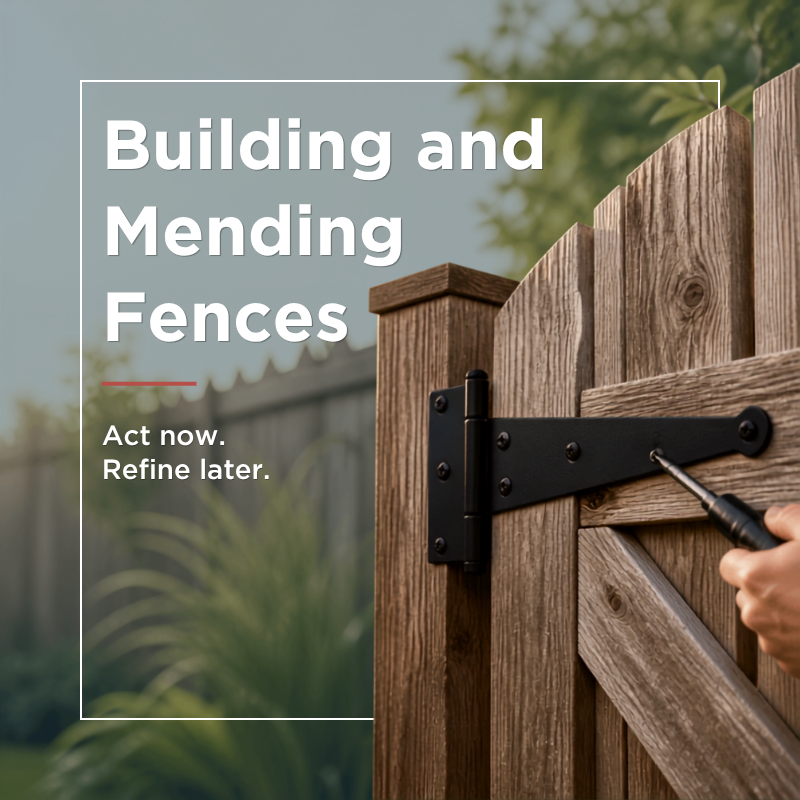
I built a fence around my yard five years ago. I had never built a fence before, but for some reason, I found the confidence and determination to take on the task. It helped that I had a compelling purpose: to allow our family dog to run freely in the yard. The dog has had plenty of fun over the last five years, to which I say, mission accomplished!
But there was a lingering issue. One of the gates I built for the fence was made intentionally wide in case we ever decided to move something larger into or out of the yard. The hinges I chose for this big and heavy gate were not built for such heavy load. Had I done more homework beforehand, I may have chosen different hardware. I didn’t, and the job was (imperfectly) done.
It was General George S Patton who said, “A good plan violently executed now is better than a perfect plan executed next week.” This closely resembles a common adage, “Don’t let the perfect be the enemy of the good.” And although it wasn’t wartime in my back yard, I think this is the sort of approach I took to the fence project.
This past weekend was a long weekend, and I used the extra time to mend the fence by replacing the hinges with appropriately-rated hardware. This time, I did some deeper investigation into what the most effective solution would be. It didn’t take long, and now the good fence I began five years ago is a bit closer to perfect.
I share this story with you because much, perhaps most, of what we accomplish is done “violently with a good plan.” We seize a limited opportunity or a burst of motivation and act before overthinking can slow us down. There’s nothing wrong with this. The perfectionists among you certainly know how much it can slow progress to need to get everything “just right.” The opportunity-cost of inaction is usually higher than the cost of a few flaws or errors.
But eventually we must take another look at our “good work” and make a choice. Does the fence still serve the purpose for which it was created? Do I know why I built the fence in the first place? If the fence is necessary, how can I improve on it? What type of modifications should I make to it so that it serves the current needs rather than those of the past?
I suppose what I am advocating is flexible judgment. If you want to build a fence (or write a novel, or pitch a new idea, or design a website), give yourself the grace to go ahead and do it. You’ll probably learn a lot in the process, and discover gaps and imperfections in your work. Then, you can use these learnings to rethink, tinker, and improve, after the dust of the “violently good” has settled.
If you want advice for getting into action (or building fences as an amateur) send me an email at [email protected].
Comments (0)